

Purchase tickets here.
“The Jungle is dark but full of diamonds.” — Arthur Miller, Death of a Salesman
What is a Tragedy?
Praised by Aristotle as the most refined of the ancient theatrical forms, Greek tragedy aroused pity and fear in its spectators only to purge those very passions. At their best, tragedies were and continue to be careful examinations of societal structures, limiting customs, and the flawed, degraded self.
As American playwright Arthur Miller articulates, tragedy “is the consequence of a man’s total compulsion to evaluate himself justly,” and to lay his inquisitive eyes on the “seemingly stable cosmos.” Miller’s use of “justly” implies that the protagonist must conduct their examination with unflinching honesty and a willingness to sacrifice their lives. A character’s insistence on challenging depravity is responsible for their ultimate demise.
Traditionally, tragic productions have featured fallen monarchs and noble warriors rather than relatable neighbors. Indeed, in his Poetics, Aristotle maintains that a tragedy must center on a character of greater renown than the ordinary person, so that their fall into misfortune carries greater weight in contrast to their former standing.
Arthur Miller disagrees. Tragedies, after all, continue to resonate with modern audiences because they fixate on the individual’s disempowerment and alienation from purpose. And it’s no longer, and perhaps never was, the king who understood these emotions best, but rather the “common man,” kneeling at the monarch’s feet, who has grown intimate with the anguish of marginalization.
Death of a Salesman
In his 1949 play, Death of a Salesman, Miller highlights the commoner’s plight. Set in post-war Brooklyn, Salesman replaces tyrannical sovereigns and warring houses with the modern villain: soulless capitalism. The play begins with Willy Loman, an aging traveling salesman suffering from depression and disastrous delusions, returning home. Over the course of three hours, the production chronicles Loman’s last day alive, as he argues with his two sons and searches for ways to stabilize his family’s finances.
But the repose Loman seeks, following decades of tireless service, evades him. Fired from his job and unable to pay off his crippling insurance premium, the salesman is forced to rely on handouts from his friend Charley to survive. Each dollar Willy begrudgingly takes from Charley’s outstretched palm robs the already suffering man of his meager dignity.
Interspersed throughout are reenactments of poignant memories. Ben, Willy’s older brother, floats in and out of the set whispering of Alaskan opportunities. Jungles full of diamonds, forests hiding endless profits, lie just across the continent, over the horizon, just out of reach. Having won his fortune through luck and ingenuity, Ben embodies the American dream. "...That man was a genius, that man was success incarnate!” Willy laments, “There was a man who started with the clothes on his back and ended up with diamond mines!"
As new buildings begin to surround the Loman household, blocking the afternoon rays that once promised a prosperous future, Willy grapples with justified disenchantment. Living through a period of unparalleled growth, Willy Loman, like millions of blue-collar American workers, struggles to survive.
Miller, a proponent of left-wing ideology, presents the misery at the core of the booming American economy. The author examines the ills of the pursuit of material wealth, but his focus is squarely on the American worker’s loss of dignity. Loman's affliction, though partly psychiatric, is ultimately a condition for which society bears responsibility.
That he even contemplates taking his own life to leave his sons an insurance payout exposes how the ordinary American has been ruthlessly dehumanized by enterprise. Every man’s worth is carefully tallied in dollars. Exploitative insurance companies and greedy executives strip Willy of his humanity, of his ability to care for his family.
Now on Broadway
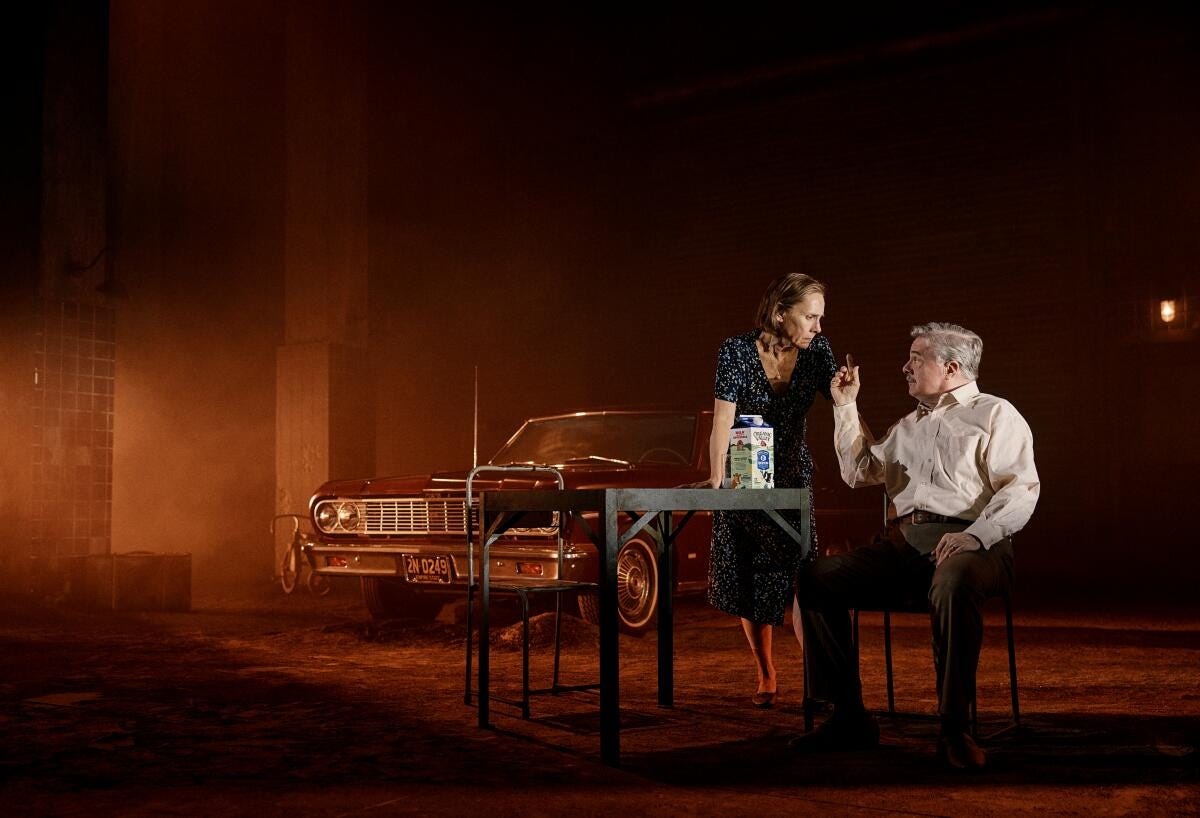
On Broadway through August 9th, Joe Mantello’s rendition of Arthur Miller’s classic tragedy asks viewers to reflect on the parallels between Willy’s desolation and the disillusionment in our modern America. Mantello’s set forgoes a conventional domestic setting for a decrepit industrial warehouse, flanked by columns of crumbling tile. The set evokes memories of the strength of American manufacturing, while illustrating the era’s rampant moral and political corruption. Mist consumes the stage, providing a melancholic, dreamlike space where the play’s quarrels and ruminations transpire.
Nathan Lane plays Willy Loman and is joined onstage by Laurie Metcalf as Linda Loman. Metcalf’s extraordinary performance benefits from her ability to hide layers of anger and despair behind an eager smile, layers that slowly reveal themselves as Willy descends further and further into madness. As Linda’s excitement at her husband’s arrival fades and gives way to frustration, her demeanor transforms. Metcalf quickly substitutes her bright eyes and open arms for drooping shoulders and hysterical appeals.
Christopher Abbot as Biff and Ben Ahlers as Happy also shine with their witty deliveries and heart-wrenching soliloquies. Abbot’s descriptions of life out west, delivered while looking out over the heads of the audience, allow us to feel the difficulty Biff has had with self-discovery. Another man lost in the great American century.
Conclusion
By showcasing Willy’s condition, Miller allows us, the American public, to identify the ills of our contemporary society and consider the root causes of inequality. We do not have to subscribe to Miller’s full-throated critique of capitalism to appreciate the validity of the problems he identifies. As AI threatens to eliminate millions of jobs and atomize our already isolated communities, preserving dignity must remain one of our top priorities.
No American should have to consider suicide as a means of jumpstarting their children’s lives. Miller claims tragedy does not have to “preach revolution.” But it must catalyze the audience to act, to rectify wrongs and mend wounds. It is when Americans lose their dignity that populism thrives, replacing the liberal institutions that could actually improve their lives. “The possibility of victory must be there in tragedy,” Miller writes in 1949, “in them and in them alone, lies the belief-optimistic…in the perfectibility of man.”
References
All quotations are taken from Arthur Miller’s 1949 piece, Tragedy and the Common Man, published in the NYT: https://archive.nytimes.com/www.nytimes.com/books/00/11/12/specials/miller-common.html