

Purchase Fiklins’ The Forever War here.
“Talking to (him) that day, and (him) and the other Talibs, it seemed obvious enough that what lay at the foundation of the Taliban’s rule was fear, but not fear of the Taliban themselves, at least not in the beginning. No; it was fear of the past. Fear that the past would return, that it would come back in all its disaggregated fury. That the past would become the future. The beards, the burqas, the whips, the stones; anything, anything you want. Anything but the past” — Dexter Filkins, The Forever War
Memories of War
To understand war, it must be felt. Missiles slamming into dilapidated buildings. Cracks from snipers hidden amongst the wreckage of elementary school classrooms. Spines intact beside dirt roads stretching endlessly into the clouds. Wailing.
Analyses written in third person for the Times that are filled with statistics, while accurate in the abstract, could not do less to convey the truth on the cratered floor of war. Few journalists understand the centrality of capturing tragedy better than Pulitzer Prize-winning New York Times Journalist Dexter Filkins. In his 2008 collection of memoirs, exploring his time in Afghanistan and Iraq, Filkins omits all political and historical context in favor of scenes, bound together without regard for chronology. As if the chaos of war itself has scrambled the conventional timeline, the visceral memories break and burst at the seams of the readers’ Western mundanity. “Your days may die, but your dreams explode,” Filkins writes when back stateside, “Not with any specific recollections; they were more the by-products of the raw materials I carried back. Rarely anything I ever actually saw.”
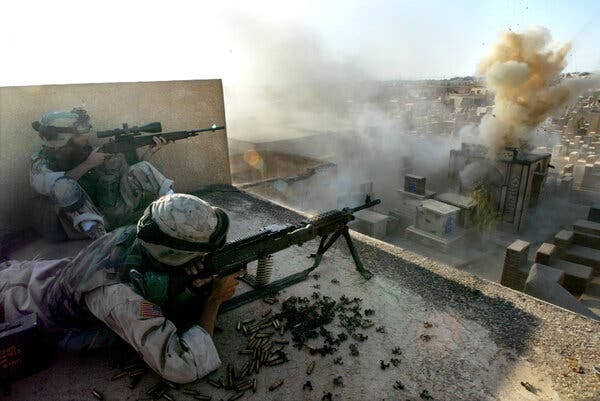
Filkins recounts his many adventures living in compounds and journeying out in Humvees alongside Bravo Team Marines. In one scene, the author conjures the streets of Falluja during an American counterinsurgency operation. “My face! My face!” yells Jake Knospler, only a kid from Pennsylvania. His jaw had been blown off by an insurgent grenade. Soldiers collapsing by Filkins’ side. Bullets whizzing past his ears.
America’s decision to invade Afghanistan and Iraq was supposedly driven by a belief in abstract principles. Democracy. Liberty. What Bush failed to recognize, or at the very least visualize, is that the implementation of abstractions requires physical actions. The same blood is spilt regardless of why bullets have been shot. Bullets do not care for morals. Referencing the lack of Arabic fluency amongst American soldiers, Filkins observes that “for many Iraqis the typical 19 year old army corporal from South Dakota was not a youthful innocent carrying Americas good will, he was a terrifying combination of firepower and ignorance.” From the perspective of an Iraqi, who had dozens of their family members killed by American arms, it is difficult to believe those same men brought liberation.
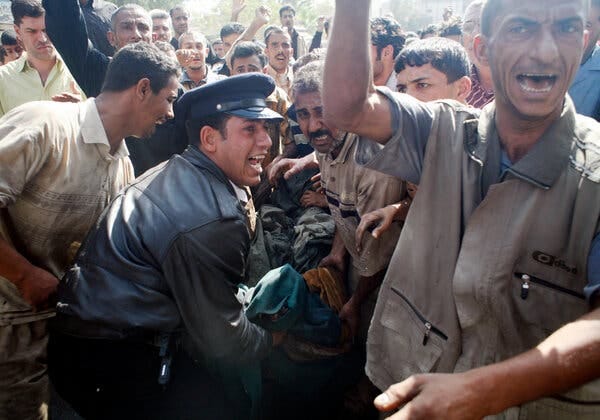
No capital expenditure on infrastructure can justify foreign occupation. In most cases, true liberation must come from within. Americans, together with their NATO allies, may have freed Iraqis from Saddam’s brutal regime, notorious for barbarous torture. But their invasion replaced one form of hell with another. The emergence of sectarian terrorist groups was not inevitable. Contrary to far-right opinion, Islam does not condone Al-Qaeda’s violence. The origin and staying power of fundamentalist organizations are tied directly to American policy. Filkins illustrates the inferno and chaos that settle upon the Iraqi desert and in the urban center of Baghdad, once a wonder of the Ancient world. Car bombs and kidnappings dominate the lives of the average citizen, while foreigners and government officials recede into armored layers, away from the violence, away from the world.
Again?
As I write, American and Israeli missiles hit cities across Iran, destroying military capabilities at the expense of civilian lives. Just beneath the voices of officials justifying war in the Middle East with a nuclear program, I hear echoes of President Bush speaking to the nation. Iraqi weapons of mass destruction threatened the free world. It was our responsibility to wipe them out.
There were no nuclear weapons in Iraq in 2003. There aren’t any in Iran in 2026. We are waging a war, killing thousands after having repeatedly rejected Iranian proposals for a renewed nuclear agreement. Strikes were not inevitable. America chose to put its own service members in harm’s way. America chose to upend the global economy. America chose to enter into another entanglement in a region that many top officials do not understand. It is not too late to prevent another ground invasion where thousands of Americans could lose their lives. Iran is not yet Iraq. The Forever War illustrates why we should ensure it doesn’t become another.